
Jul 14, 2026
Jun 5, 2025
Proven Longevity and Decoding Accuracy With Connexus® BCI
This blog was updated from three to four years of stable recordings on October 8, 2026.
Recent brain-computer interface (BCI) research shows exciting results. In June, researchers from the BrainGate consortium, a collaboration spanning UC Davis, Brown, Emporium, Stanford, Massachusetts General Hospital, and other institutions reported in Nature Medicine that a man with ALS used an investigational intracortical BCI at home for nearly two years, decoding his attempted speech with over 99% word accuracy without any researchers present.
These successes fuel optimism and showcase the potential of emerging technologies in healthcare innovation.
However, ask anyone who might consider neurosurgery to receive a BCI, and one priority quickly emerges: long-term reliability. Patients want a device that serves them for years, ideally for the rest of their lives. This means that BCIs, like all implanted medical devices, must withstand the harsh biological environment of the body, operate reliably over time, and minimize the need for a risky replacement surgery.
In a previous blog, we outlined the three pillars that guide every design decision at Paradromics, arguing that safety, performance, and durability should never be treated as tradeoffs, but minimum thresholds. Of the three, durability is often considered the hardest to demonstrate, as only time can prove it. Our preclinical in vivo program was designed to test this alongside safety, following both the animals and the signals their devices record across years of implantation.
In this article, we share data from our preclinical research demonstrating over four years of reliable neural recordings that strengthen the foundation for translational research and clinical adoption of the Connexus® BCI.
Key Findings From Preclinical Research in BCI
- We have conducted safety and functional testing in the sheep auditory cortex (the part of the brain that processes auditory information).
- In over four years of data collection from our R&D electrode array, we demonstrated our ability to record stable neural signals over time, with practically no degradation in signal-to-noise ratio, and sustained decoding accuracy over time.
- In functional testing of the fully-implanted Connexus BCI over nearly two years, we have measured similarly high signal-to-noise ratio and even better decoding performance compared to the R&D device.
Animal Testing as a Foundation for Translational Research
At Paradromics, we perform our safety and functional testing in sheep using acoustic stimulus paradigms. Compared to the human brain, sheep have similar brain folding (i.e., sulci and gyri) and cortical architecture; thus, sheep are commonly used in translational research (John et al. 2017; Opie et al. 2018) and in preclinical research of neuromodulation devices.
The sheep auditory cortex in particular accommodates the placement of our Cortical Module in a configuration representative of human-use implantation, while also supporting our surgical technique and instrument development.
As will be the case in human implantation, Cortical Modules are placed subdurally, directly on the surface of the sheep brain. This results in hundreds of thin microelectrodes (40 µm in diameter) extending 1.5 mm into the auditory cortex from which neural signals are recorded.
Furthermore, because the electrodes are placed in the auditory cortex, by playing acoustic stimuli (i.e., pure audible tones) for the sheep, we can observe the stimulus-driven response in the neural recordings as the sounds are heard.
Below we present two sets of animal study results: first, a four-year follow-up of our R&D testing of the Connexus electrode array, and second, a two-year follow-up results of a cohort implanted with the full Connexus BCI for a prospective functional animal study, which we continued to test beyond the original six month end-point.
Long-Term Preclinical Research on the Connexus Electrode Array
To assess the Connexus electrode array in vivo, we implanted two sheep with a Cortical Module representative of the final finished device, placed within the auditory cortex.
This experimental system records neural signals periodically across the full lifetime of the implant, allowing us to assess long-term neural recording performance in a model system that shares similar structural features with humans, including pia thickness, skull thickness, and cortical folding.
Through this four-year follow-up period with ongoing data collection, we have observed no electrode array migration, the sheep are healthy, the recorded neural signals remain stable, and we continue to successfully decode neural responses to acoustic stimuli.
This extended preclinical research period provides strong evidence in device longevity to support clinical trials.
Neural Signal Features Identified in Preclinical BCI Testing
The figure below shows data collected 1,470 and 1,443 days post-implantation for Sheep 1 and 2, respectively. For each sheep, we show example output traces for four channels from the Cortical Module.
These traces have been filtered to focus on the neural spiking band (i.e., the frequency band used for decoding neural activity). Each spike represents a neuron firing; for each spike that reached a certain threshold, we made a tick mark.
The pattern of tick marks across time are referred to as a raster plot and form a set of threshold crossing features. These features, measured for each channel simultaneously, are then input into the data analysis pipeline for neural decoding.
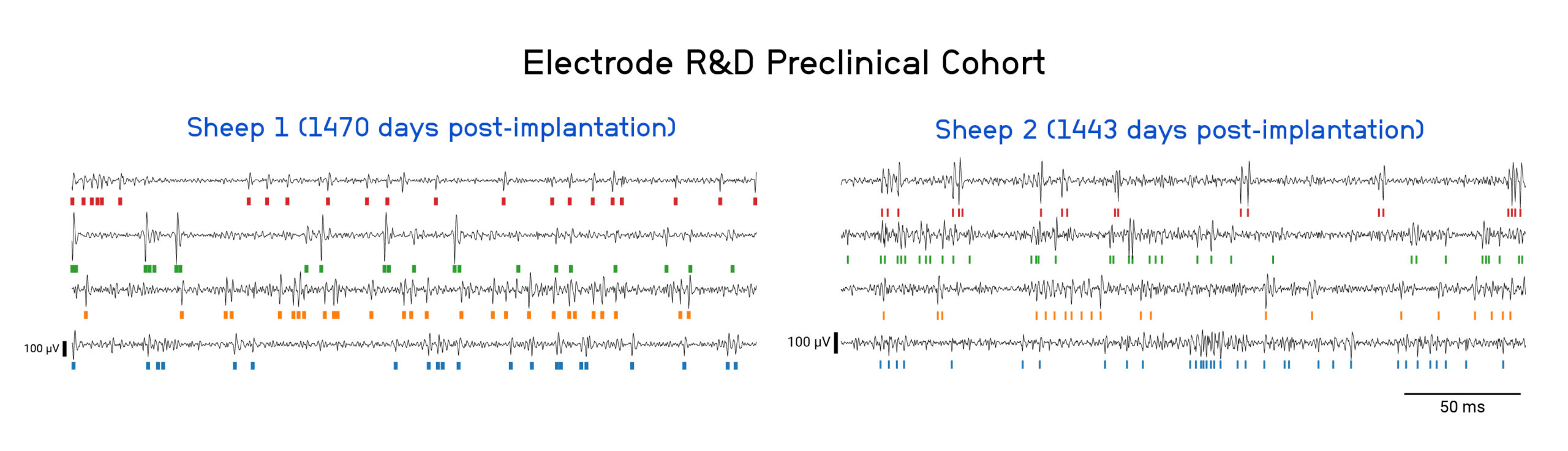
The red, green, orange, and blue tick marks indicate threshold-crossing neural spikes. For clear visualization, 4.5x threshold-crossing neural spikes are indicated. Neural spikes captured using a 3.5x threshold are fed into the data analysis pipeline for neural decoding to fully capture the relevant neural activity.
Assessing Neural Recording Stability Through Preclinical Research
To this day, we continue to record robust spiking activity in these animals, and the spike signal-to-noise ratio (SNR) across both sheep has reached a stable plateau. Spike SNR is a measure of signal quality; the higher the ratio, the better the signal quality.
This high SNR (>5) for our cortical module recordings in sheep is as good or better than those published for chronically implanted Utah Arrays in the rhesus macaque motor cortex, which ranged from 1.5 to 4 (Sponheim et al. 2021).
The Utah Array is a research device that has enabled high-performance BCIs [Willett, et al. 2023; Card, et al. 2024; Willsey, et al. 2025; Singer-Clark, et al. 2025]; however, this device has a highly variable functional lifespan.
Below is a graph of our Cortical Module’s spike SNR over time. Note that at about 600 days post-implant, the ongoing recordings were paused to focus on a new cohort of animals for the Connexus BCI prospective study, with recordings resuming at about 800 days, resulting in a gap in the data.
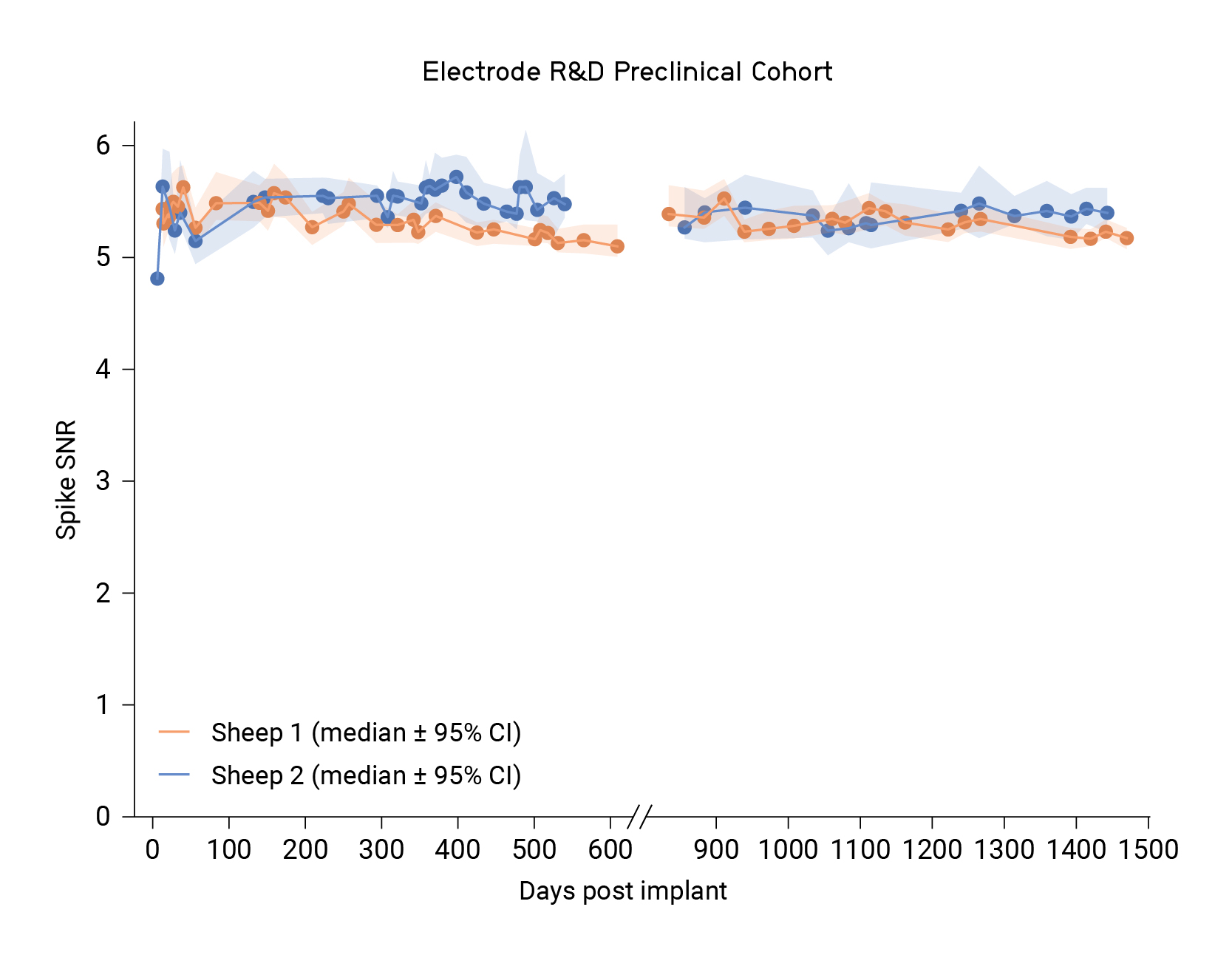
Longitudinal tracking of spike signal-to-noise ratio (SNR) across channels in Sheep 1 and Sheep 2 over four years. Spike SNR per channel: average spike peak-to-peak amplitude across all threshold-crossing (4.5x) events divided by 2 × standard deviations of background multi-unit signal.
Decoding Stimulus Responses to Advance Translational BCI Research
In addition to analysing the raw neural signal output, we studied the ability to record and accurately decode the neurophysiological response to acoustic stimuli.
To do this, we played short, pure tones at distinct frequencies for the sheep and simultaneously recorded the stimulus-driven spiking activity from hundreds of channels. Then, our decoding algorithm identified the frequency of each tone stimulus based on the recorded neural activity.
Within about 10-15 ms after the tone began playing, many of the auditory neurons fired more vigorously than their baseline activity. We leverage the data patterns across electrode channels and time for these stimulus-driven neural responses to develop effective decoders.
The figures below are data visualizations of a neural latent space. In machine learning, a latent space represents complex data, such as neural recordings from hundreds of channels, in a more compact form to make patterns and features easier to identify and learn.
These loop-shaped trajectories represent the stimulus-driven neural response for the 150 ms after the tone begins. On the top left, the individual temporal trajectories are plotted for 4 different tone frequencies (represented with different colors) with 30 trials per sound.
Each of these trajectories is generated by mapping neural recordings from hundreds of individual electrode channels to the three dimensional latent space shown. The plot on the right represents the average neural response across trials for each stimulus condition. The animated plot on the bottom shows how these trajectories develop over the 150 ms of the neural response to the sound.
Our decoder leverages the consistent structure of these neural trajectories in latent space to identify the stimulus tone; as shown below, each tone was represented as a distinct trajectory occupying a distinct area in the latent space.
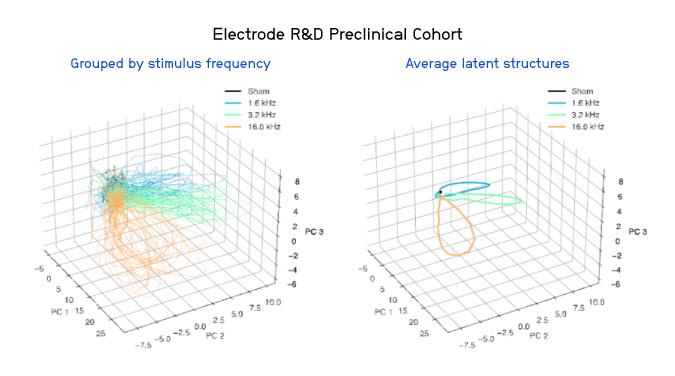
Visualizing stimulus response. Each stimulus trial condition (tone frequency) is color coded. The latent neural traces occupy different parts of the latent space, i.e. the colors are separated in this space. As expected, the sham control condition, in which no stimulus is played, shows much less variability than the stimulus conditions.
Sustained Performance in Long-Term Preclinical Research
To further assess the reliability of the Connexus electrode array, we measured decoding accuracy over time. That is, if we can accurately determine which tone was played based on the recorded neural signals, then the device continues to function effectively.
We also estimated mutual information (MI), which is the measure of how much useful information the recording signal carries about the tones.
The figure below shows that over time, we continue to extract meaningful information, with both decoding MI and accuracy remaining stable beyond the four years of data collection.
These preclinical research results are a critical step for translational research studies developing reliable high-performance BCI technology.
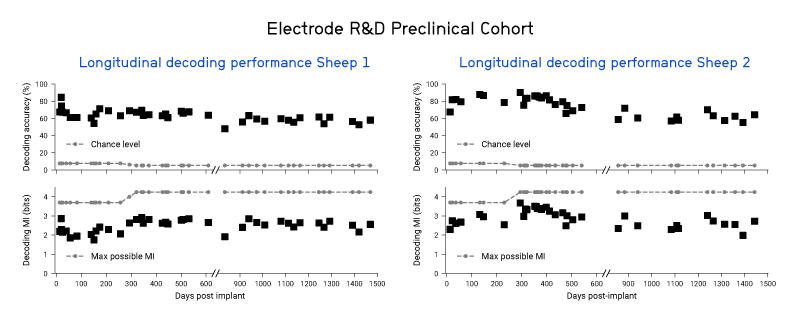
Longitudinal tracking of tone decoding accuracy and mutual information (MI) in Sheep 1 and Sheep 2 over post-implantation days.
Translational Preclinical Research Results From the Connexus BCI Study
Adding to the robust results from the Connexus electrode array, we also evaluated the neural recording stability and decoding accuracy of the fully implantable system, consisting of the Connexus Cortical Module, Extension Lead, and Internal Transceiver.
This controlled prospective preclinical research was conducted over a 26-week study period with over 6,100 active device-hours. Following the initial study period, we have continued to evaluate these devices for nearly two years.
Verifying results with the fully implantable system is an important part of preclinical research verification and validation testing to evaluate the device’s intended use.
Identifying Spiking Features in the Neural Data
We conducted long-term awake neural recordings in six implanted sheep (Sheep A–F) over the study period. The signal quality across all animals was comparable to that observed in Sheep 1 and 2 from the R&D electrode array testing.
Representative output traces from all six sheep are shown below, illustrating distinct spike events.
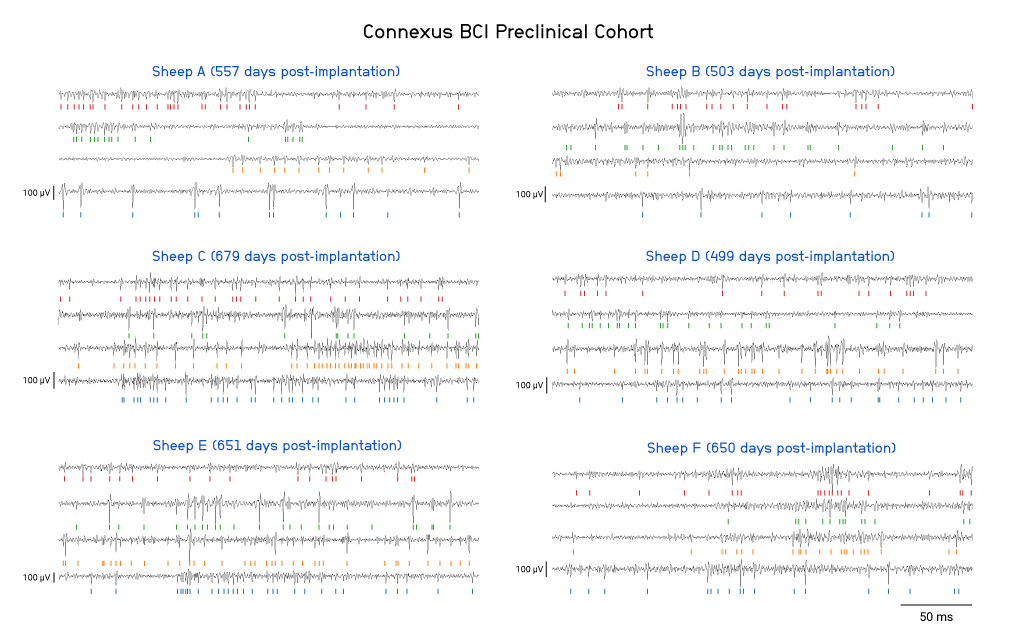
The red, green, orange, and blue tick marks indicate the threshold-crossing features that feed into the data analysis pipeline for neural decoding. Note: For Sheep A, B, and D, these data show the final neural recordings obtained prior to their scheduled device explanation for safety evaluation (Sheep A) and histopathological evaluations (Sheep B and D), respectively.
Assessing Performance of Neural Recording Over Time
Longitudinal spike SNR remained stable above 4, consistent with the signal quality observed in Sheep 1 and 2. These results demonstrate the repeatability and robustness of the device performance across multiple animals.
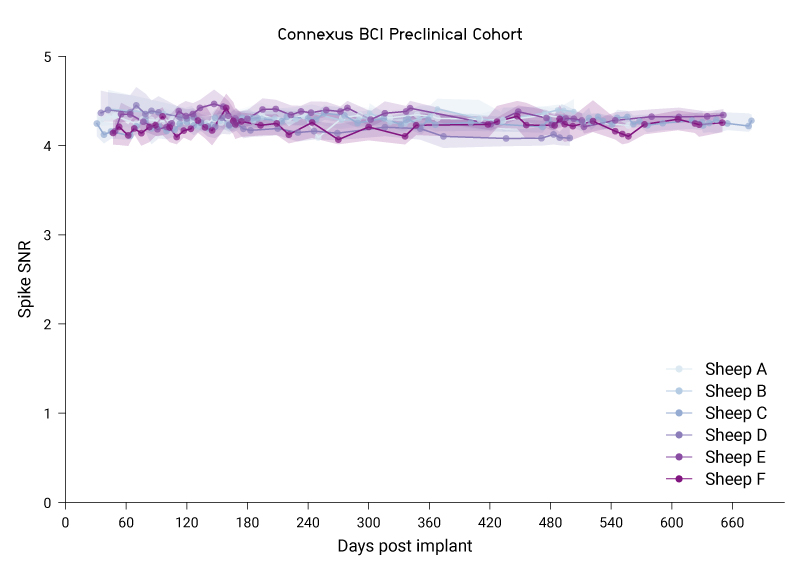
Longitudinal tracking of spike signal-to-noise ratio (SNR) across channels in 6 sheep over the two-year study period. The prospective functional animal study concluded at 26 weeks (~182 days). The data shows median +/- 95% CI.
Assessing Decoding Performance Over Time
Additionally, throughout the nearly two-year period, we were able to extract meaningful information, with decoding accuracy averaging approximately 80% across monthly assessments and consistently well above chance (14.3% for seven tone frequencies) for the lifetime of the device implantation across all six sheep.
The figure below illustrates longitudinal tone decoding performance across all six sheep.
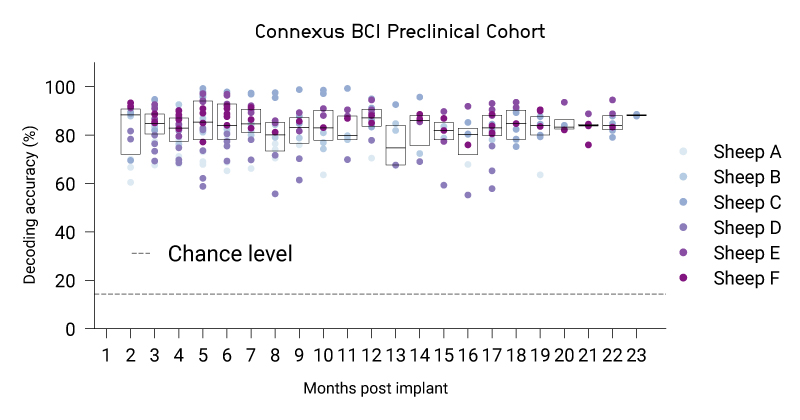
Stable tone decoding accuracy across six sheep over the nearly two-year period. Note: Sheep A had device explanation for safety evaluation, and Sheep B and D for histopathology evaluation, on schedule. Two animals from this cohort, Sheep C and E, also contributed to our measurement of the Connexus BCI’s information transfer rate using SONIC, the benchmark we developed to compare BCIs on equal terms in bits per second. We share those results in our blogs, Think Fast and in Part 2 of our Society for Neuroscience recap blog. For more information on device longevity, read Part 1.
Preclinical Research Validating Robust BCI Performance
These results demonstrate stable, high-quality signal recording over time and provide compelling evidence that the Connexus Cortical Module can reliably capture key neural features over extended periods of implantation.
This capability is critical for long-term use of high-performance intracortical BCI applications like speech decoding [Willett, et al. 2023; Card, et al. 2024; Wairagkar, et al. 2025; Card, et al. 2026] and control of computer devices [Willsey, et al. 2025, Singer-Clark, et al. 2025, Nuyujukian, et al. 2018].
These preclinical research results and translational research findings demonstrate that the Connexus BCI is reliable and information-rich, meeting key requirements for advanced applications such as speech decoding.
With the Connect-One Clinical Study now underway, marking our shift into first-in-human data, we look forward to seeing how these results translate for the individuals the Connexus BCI was designed to serve. Learn more about the study here.
If you have any questions, please reach out to media@paradromics.com.
Caution: Connexus BCI is an investigational device limited by United States law to investigational use.
Share Blog

