
Jan 20, 2026
Jan 21, 2026
Bandwidth and Latency
Bandwidth and latency are important for BCI user experience. BCI systems must respond both quickly and accurately to create a fluid experience for users in their everyday life. That is why our SONIC benchmarking framework was designed from the start to evaluate not just how much information a BCI can decode, but how quickly it can act on that information.
Publishing performance details is important, but they are not often emphasized in BCI industry news coverage. For instance, a cursory search for “speech prosthetic” will reveal that several university labs have announced “high performance” speech decoding in the clinic. However, the results coming out of top labs using intracortical electrodes (specifically at Stanford and UC Davis) and clinical electrocorticography grids (UCSF) are not the same. Intracortical recording, by virtue of its higher data throughput, allows for large vocabularies, high communication rates, low error rates, and short latencies. Electrocorticography, because it has an order of magnitude lower throughput, must work with smaller vocabularies and multi-second delays. See our Blog about the topic here.
One of our goals at Paradromics is to push the state of the art even further by building better hardware and software tools. We believe this will translate to better outcomes. We want to enable BCIs that feel natural, responsive, and capable of supporting complex behaviors like real-time communication. That requires pushing both bandwidth and latency into regimes that have historically been out of reach.
Part of our contribution to the field is to lead by building. Our other responsibility is to communicate clearly what we are building and why it is better. That is why a group of Paradromics scientists attended the 2025 Society for Neuroscience meeting in San Diego to present our benchmarking results. These results add to the findings reported in our scientific preprint, showing that the Connexus® Brain-Computer Interface (BCI) maintains an industry-leading data rate with low system latency.
ITR and Intrinsic Delay Define Which BCI Applications Are Possible
The top-line metric of our SONIC benchmarking research is Information Transfer Rate (ITR), representing the speed and accuracy of decoding. But this metric must always be reported alongside intrinsic system delay, i.e. the delay between neural activity and the decoded action dictated by measurement, signal processing, and algorithmic choices.
BCI applications vary considerably in their ITR and delay requirements, so benchmarking both metrics is necessary for evaluating which classes of applications are viable for a particular BCI system. There are a handful of applications for which very little ITR is needed and long delays in decoding are acceptable (e.g. control of a smart home system). Yet many applications are more complex and require higher ITRs (e.g. expressive large-vocabulary communication), shorter delays (e.g. cursor control), or both (e.g. real-time speech synthesis) (see Fig. 1).
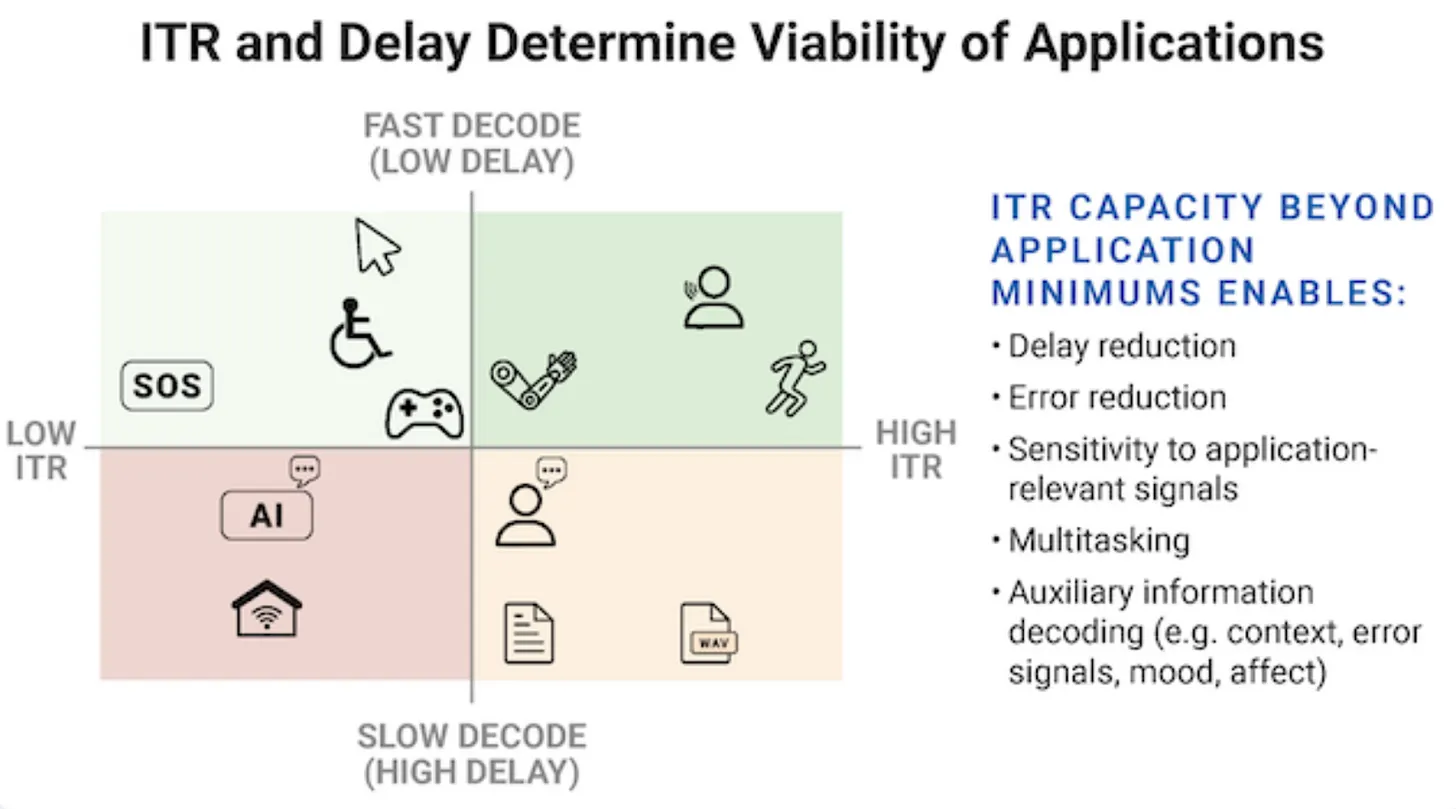
Fig. 1 High Information Transfer Rate (ITR) (x-axis) and decoding speed (y-axis) enable the most complex human capabilities such as fluid and natural speech restoration (upper right quadrant). Lower ITRs and higher delays can be tolerated for less complex tasks like controlling a smart home system (lower left quadrant).
High Bandwidth Persists Even While Reducing Latency
The Connexus BCI has demonstrated that it can achieve an ITR greater than 200 bps with an intrinsic delay of 56 ms. This is very encouraging, but still leaves open the question of how the Connexus BCI would perform when even shorter delays are necessary. To address this, we explored reducing intrinsic delay even further (e.g. via aggregating neural data over small windows) and quantifying the impact on ITR (Fig. 2). This analysis revealed that ITR remained high (> 100 bps) even as intrinsic delay dropped down to as low as 6 ms and as filter delays were reduced from 5 to 1 ms.
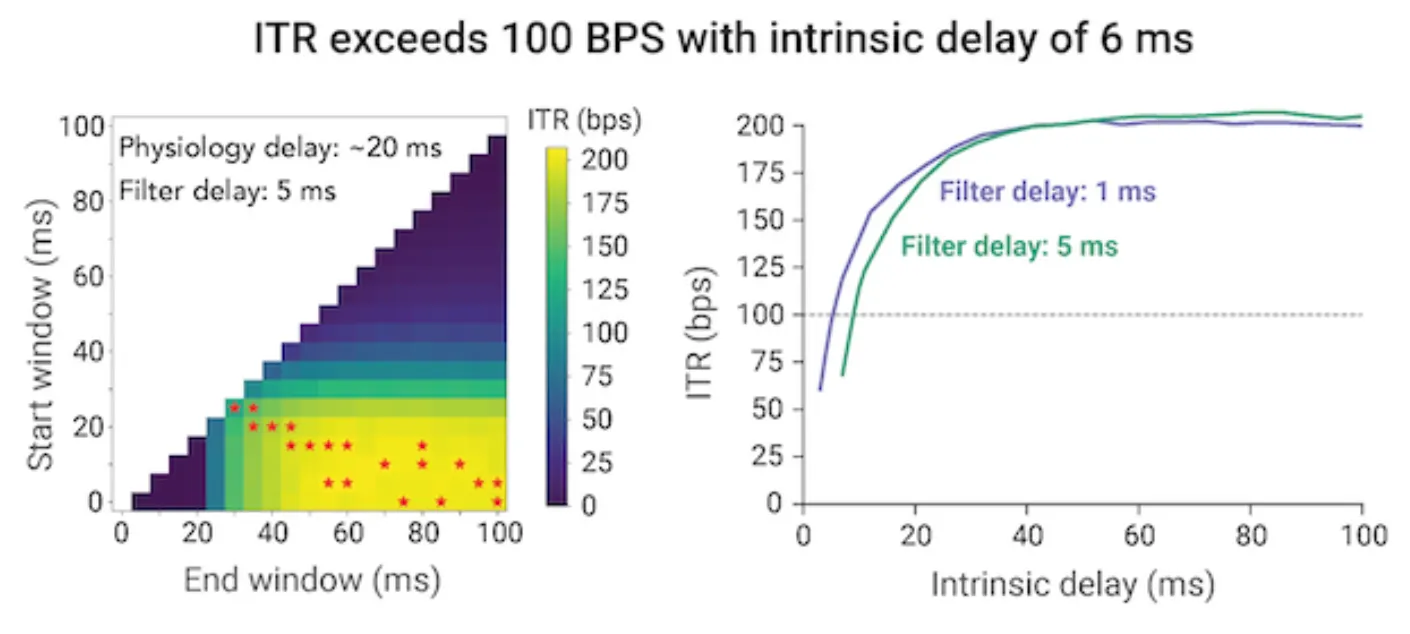
Fig. 2. Paradromics’ benchmarking results reveal that the device Information Transfer Rate (ITR) exceeds 200 bits per second (bps) across a range of time windows used for data collection (left). Importantly, there is a steep rise in ITR even as filter delays are reduced from 5 to 1 ms, and ITR exceeds 100 bps with an intrinsic delay as low as 6 ms.
Although performance in SONIC cannot be expected to generalize directly to other applications, these results show that the Connexus BCI system is capable of decoding highly complex information about the state of the brain with exceptionally low delay. In other words, a wide range of advanced BCI applications appear within reach given the capabilities of the Connexus BCI, motivating clinical investigation to explore what’s possible.
ITR as a Design Tool: The Importance of Electrode Count & Placement
In addition to establishing application viability, ITR can drive optimization of hardware and software design choices. For example, it can help us interrogate the relationship between number of electrode channels and decoding performance for a given design. To do this, we ran an electrode-dropping analysis to explore the impact of electrode count for ITR. By randomly dropping electrodes (excluding their data from analysis) over many repetitions, we generated a curve that shows how ITR would change if our device had fewer electrodes (Fig. 3).
As expected, the curve begins at near-zero ITR when only 1 electrode is present and increases toward 200 bps as more and more electrodes are added. Critically, the curve continues to rise as the number of electrodes reaches the full set of 420. This validates the choice to build the Connexus BCI with a high electrode count (performance would have been reduced if fewer electrodes were present) and illustrates that further information and performance gains will be achieved by hardware advancements that increase the number of electrodes per module, or by adding additional modules.
While electrode count is essential, placement is equally critical. For example, surface-level devices like the ECoG grid can more easily scale electrode numbers. However, they face diminishing returns in ITR, because the signals they measure are already averaged over large populations of neurons, leading to a high level of redundancy between nearby electrodes. This spatial averaging, inherent to that style of interface, destroys valuable information in areas like the motor cortex where the responses of individual neurons are complex and heterogeneous.
In contrast, the Connexus BCI’s electrodes are placed into cortical layers where individual electrodes can capture the detailed, high-resolution information that would be averaged out by a surface-level device. Thus, electrodes can be far closer together in the Connexus device than they could be on a surface-level grid while still capturing unique information that boosts decoding performance.
Although intracortical recordings can give us access to information rich single neuron data, not all intracortical spatial sampling strategies are equivalent. The sampling strategy needs to match the intended application of the technology. For BCI applications, dense neural recording, such as that provided by a Neuropixel probe, can lead to over-sampling of the cortex, where a single neuron is recorded by multiple electrodes. While this redundancy is valuable for fundamental scientific discovery by facilitating clean isolation of individual neurons, it presents diminishing returns from an engineering perspective. For high-performance BCI applications, research studies have shown that recording individual neurons is crucial, but the high-confidence isolation needed for basic science is not needed.
Furthermore, depth-sampling redundancy may also offer limited benefit from an engineering and BCI performance perspective. For example, Neuralink’s clinical studies with the N1 device, presented at the 2025 BCI Society Meeting, used laminar electrodes that sampled across several millimeters of depth. While interesting from a basic science discovery standpoint, their findings, consistent with neuroanatomical and physiological understanding, indicate that the most critical electrodes for BCI are located around 1.5 mm deep. Therefore, targeting this specific depth for most or all electrodes may be more effective than employing a laminar approach.
What about Connexus? When would our data rates likely plateau as a function of electrode count? We are recording from a 2-D array of electrodes, all placed at 1.5 mm depth, spaced 300 micrometers apart. Based on paired neuron recordings in cortex, we would not expect to see much redundancy before we begin recording electrodes within 100 micrometers of each other.
In summary, our analysis suggests that adding additional channels to the Connexus cortical modules (i.e., increasing electrode density by up to approximately an order of magnitude) would meaningfully increase its performance, but that does not mean that any higher channel count BCI system would have meaningfully higher performance. For ITR, both electrode count and distribution are critical.
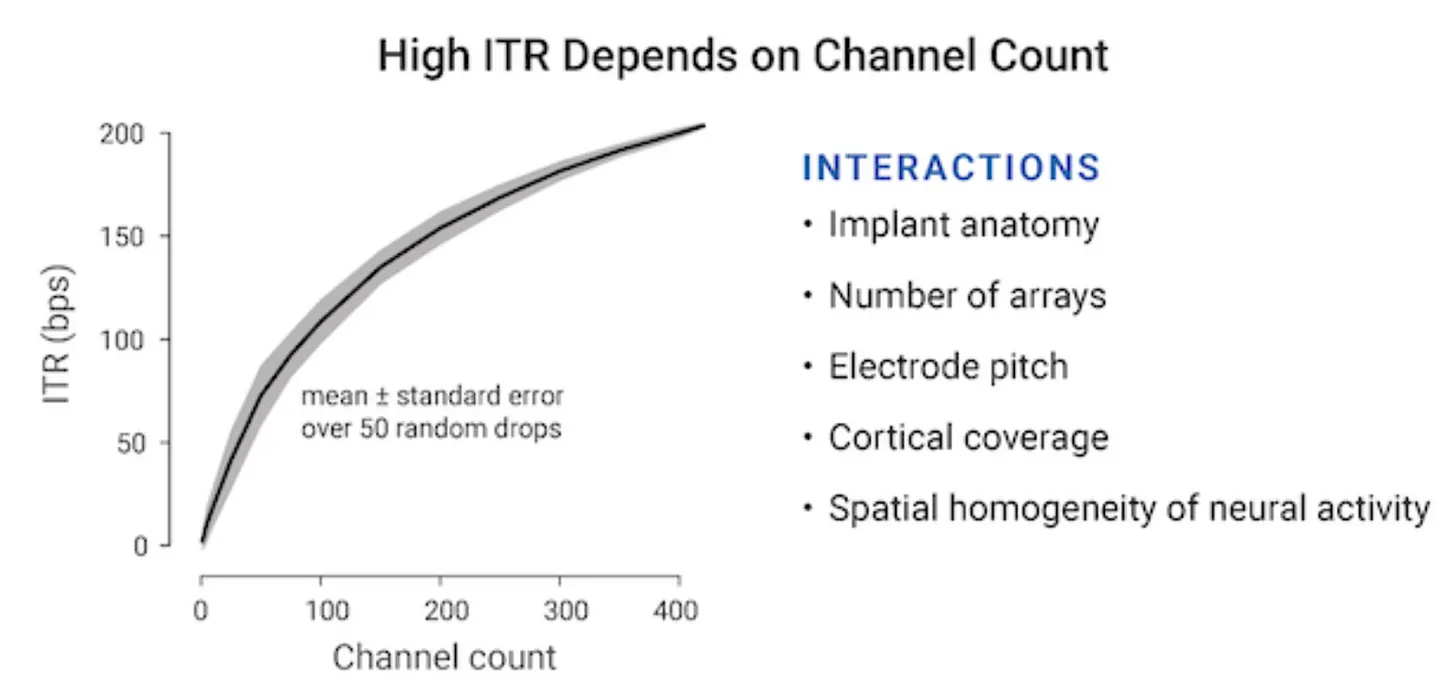
Fig. 3. ITR continues to rise as electrode count increases from 1 to 420, supporting the additional value of continuous hardware advancements that further increase electrode count, information rate and ultimately, the variety and quality of BCI applications.
Summary: The Connexus BCI Demonstrates High Information Throughput Even at Exceptionally Low Intrinsic Delay
By jointly measuring ITR and intrinsic system delay, SONIC provides a clear, application-relevant picture of decoding performance. The Connexus BCI achieves ITRs greater than 200 bps at a delay of 56 ms, and critically, maintains ITRs above 100 bps even as intrinsic delay is reduced to as little as 6 ms. This combination of high bandwidth and ultra-low latency establishes that the device can support the accuracy and speed needed for complex real-time applications like speech restoration.
Beyond benchmarking, ITR also functions as a principled design tool. Our electrode-dropping analysis shows that performance continues to increase as more electrodes are added, with no evidence of saturation at the Connexus BCI’s full electrode count. This validates the high-density architecture of the Connexus BCI and suggests that further scaling will unlock even greater decoding capacity. Together, these results indicate that the Connexus BCI is not only viable for a wide range of advanced BCI use cases, but is also built on a foundation that can continue to grow with improvements in hardware and software.
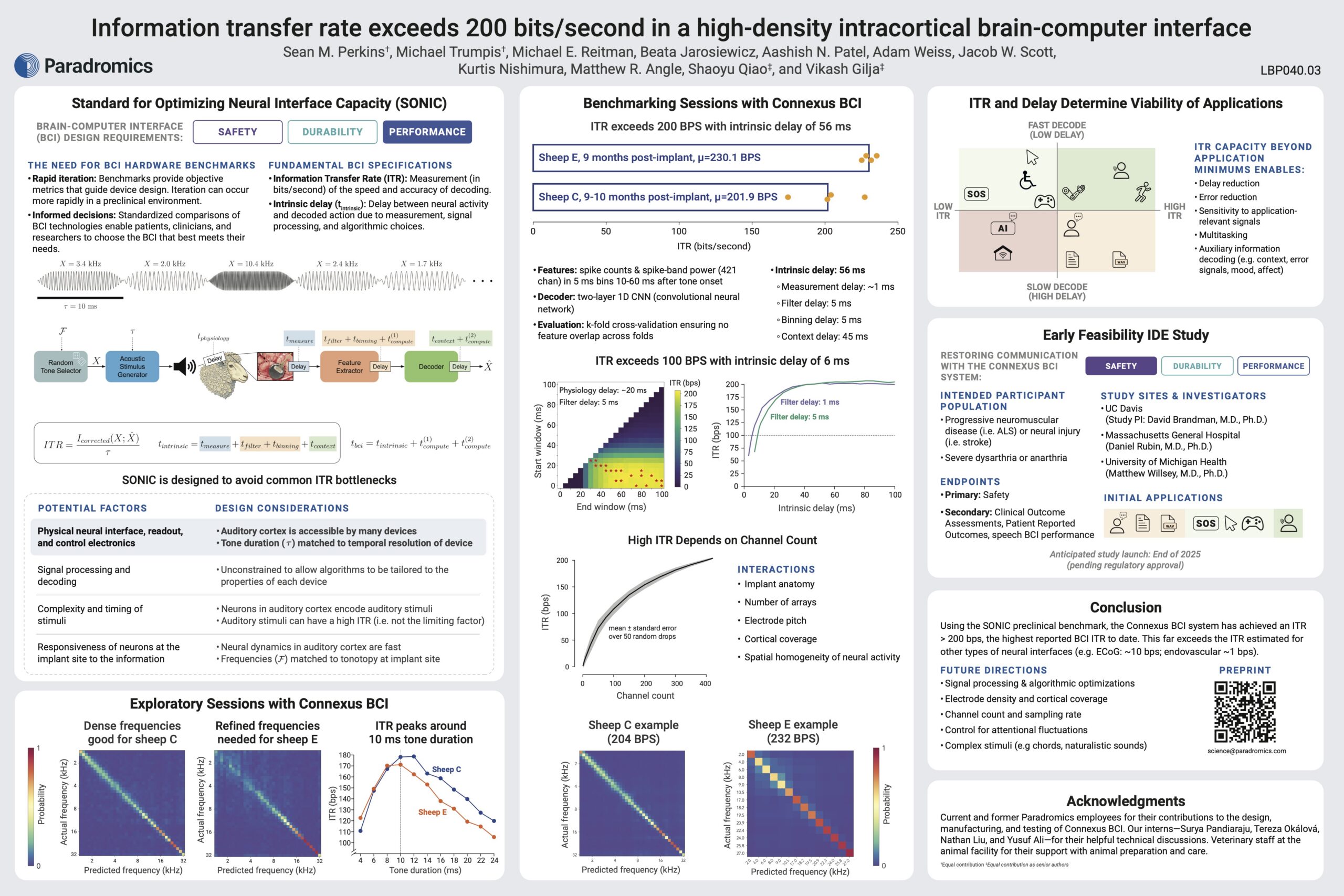
Click here for a closer look at the SfN poster.
Share Blog

